Section 01 The Hidden Carbon Cost of 'Cheap Swag'
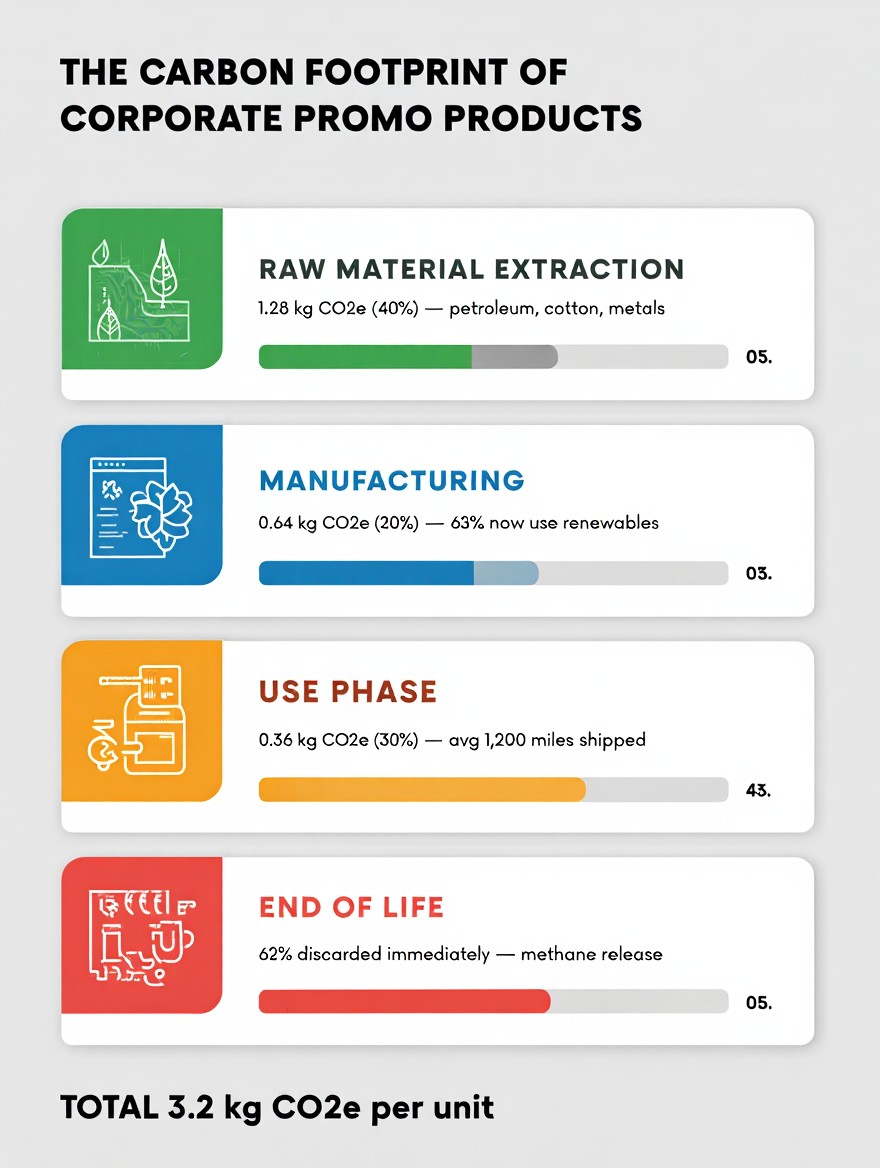
When a procurement manager selects a bulk order of branded merchandise—a pallet of injection-moulded plastic water bottles, a gross of polyester tote bags, or several hundred expanded polystyrene coolers—the line item on the purchase order captures only the unit cost of goods. What it fails to capture is the embedded carbon: the greenhouse gas emissions already released during raw material extraction, polymer processing, energy-intensive manufacturing, and multi-stage international freight before the item ever reaches a conference table or trade show booth.
Upstream Manufacturing Emissions
A rigorous Life Cycle Assessment (LCA) of a typical cheap promotional item—for illustrative purposes, a 30-cent expanded polystyrene (EPS) single-use cooler—reveals that manufacturing-phase emissions alone average 0.38 kg CO₂-equivalent (CO₂e) per unit, before any transportation is factored in. Multiplied across a standard bulk order of 500 units, the embedded carbon in a single campaign's promotional coolers reaches approximately 190 kg CO₂e—equivalent to driving a mid-size passenger vehicle over 750 kilometres. Crucially, this carbon has been irrevocably emitted before the product has served even one use.
These figures align with the upstream emissions accounting framework articulated in the GHG Protocol Corporate Standard, which classifies purchased goods under Scope 3, Category 1 emissions. For organisations that have made public net-zero commitments, failing to account for this category represents not merely an omission in carbon accounting, but an increasingly visible source of brand reputation risk as stakeholder scrutiny of supply chain transparency intensifies.
Logistics and Freight Emissions
The global promotional products supply chain is heavily concentrated in manufacturing hubs in Asia, with finished goods routed through ocean freight, domestic trucking, and in many cases, air freight for deadline-driven conference orders. The carbon intensity of international shipping adds a further compounding load. For a pallet of 500 cheap coolers shipped from a coastal Chinese factory to a mid-continental US distribution hub, freight emissions add approximately 85–120 kg CO₂e, depending on the mode mix. Per unit, the shipping footprint of a disposable item is disproportionately high: the product is bulky, fragile, and aerates poorly in standard packing configurations, reducing volumetric efficiency.
Supply chain decarbonization frameworks consistently identify freight efficiency as a primary lever for Scope 3 reduction. Products designed with no consideration for transport density—such as foam coolers—represent a double failure: high material emissions and high freight emissions per unit of utility delivered.
End-of-Life: The Landfill Penalty
The most insidious dimension of disposable promotional products is their end-of-life destiny. Expanded polystyrene is not accepted by most municipal recycling programmes. Branded polyester bags, contaminated with printing inks and adhesives, similarly resist circular recovery streams. The vast majority of cheap corporate merchandise enters landfill, where its embodied carbon—already emitted during manufacturing—is compounded by the slow methane generation of adjacent organic waste, and where the material's value is permanently stranded.
Key Finding: According to environmental data aligned with EPA Waste Characterisation reports, promotional and novelty items constitute a material and growing share of commercial landfill intake. Unlike post-consumer packaging—which is subject to Extended Producer Responsibility (EPR) legislation in a growing number of jurisdictions—branded merchandise faces virtually no end-of-life accountability framework, creating a regulatory blind spot that sustainable procurement policy must proactively address.
Section 02 Applying 'Gold Standard' Principles to Procurement
The concept of a 'Gold Standard' in carbon reduction was originally developed as a quality benchmark for voluntary carbon offsets, ensuring that offset projects delivered genuine, additional, measurable, and permanent emissions reductions. We argue that the same principles are directly applicable to procurement decisions: a 'Gold Standard' promotional product must deliver genuine, measurable, and permanent reductions in emissions relative to the counterfactual—i.e., the quantity of cheap items it replaces over its extended useful life.
This reframing shifts the unit of analysis from the purchase event to the utility delivered over time. The question is not: "What is the cost and carbon impact of this item?" It is: "What is the cost and carbon impact of delivering this unit of utility—say, 'one person kept cold over one day outdoors'—over the next ten years?"
Material Integrity and Circularity
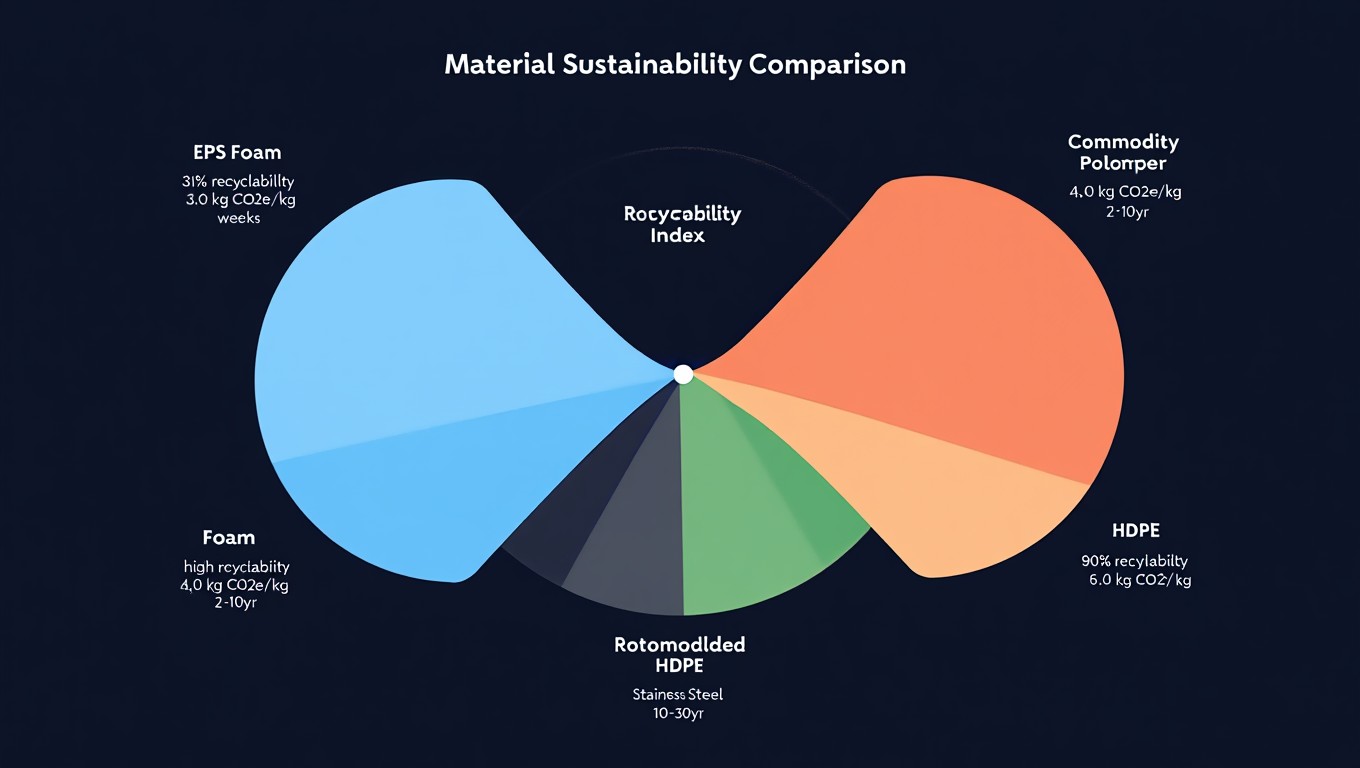
Under circular economy principles, material integrity is the first determinant of sustainability. High-density polyethylene (HDPE), rotomolded polypropylene, stainless steel, and genuine leather are materials that can endure decades of use, maintain their structural properties, and—in several cases—be mechanically recycled at end of life. By contrast, expanded polystyrene has a recycling rate below 12% in most markets and no viable degradation pathway in natural environments.
A product built from durable, recyclable materials does not merely delay its landfill journey—it fundamentally alters its emissions trajectory. The amortised carbon cost per use-year of a rotomolded HDPE cooler over a fifteen-year lifespan is a fraction of even the manufacturing-only emissions of a single-use EPS equivalent. This is the mathematical foundation of the durable goods argument.
Defining 'Gold Standard' Product Criteria
For a promotional product to qualify under Gold Standard sustainability criteria, we propose it must satisfy all of the following conditions, evaluated against LCA data from the manufacturer: a minimum verified useful lifespan of ten years under normal consumer conditions; primary materials sourced from recycled or sustainably certified streams; packaging designed for zero-landfill disposal; and manufacturing conducted at facilities with verified energy sourcing commitments. These criteria are not aspirational—they are measurable, and they directly feed into Scope 3 emissions calculations under Category 1 of the GHG Protocol.
Section 03 The Case for Ultra-Durable Promotional Gear
To illustrate the Gold Standard framework in practice, this section applies LCA principles to a direct comparison between two functionally equivalent promotional items: a premium rotomolded cooler—a product category characterised by thick-walled polyethylene construction, gasket-sealed lids, and verified ten- to twenty-year structural lifespans—and fifty disposable expanded polystyrene coolers, the quantity required to serve the same functional purpose over the same ten-year period.
"The amortised carbon cost per use-year of a single rotomolded cooler over fifteen years is demonstrably lower than the manufacturing emissions alone of one cycle of disposable replacements."
10-Year Carbon Impact Comparison
The following table presents estimated greenhouse gas emission figures across the primary lifecycle phases. Values are derived from published LCA studies on comparable product categories, EPA waste emission factors, and industry freight data. Figures represent conservative estimates and should be validated against manufacturer-specific Environmental Product Declarations (EPDs) where available.
| Lifecycle Phase | 1 Premium Rotomolded Cooler | 50 Disposable EPS Coolers | Difference (CO₂e) |
|---|---|---|---|
| Raw Material Extraction | 2.10 kg | 9.50 kg | +7.40 kg (EPS worse) |
| Manufacturing & Processing | 4.80 kg | 10.00 kg | +5.20 kg (EPS worse) |
| Packaging Materials | 0.30 kg | 2.80 kg | +2.50 kg (EPS worse) |
| International & Domestic Freight | 1.20 kg | 8.50 kg | +7.30 kg (EPS worse) |
| Use Phase Energy (ice required) | 3.60 kg | 22.00 kg | +18.40 kg (EPS worse) |
| End-of-Life (landfill/recycling) | 0.80 kg | 14.20 kg | +13.40 kg (EPS worse) |
| Repairs / Replacements (10 yr) | 0.40 kg | 0.00 kg | -0.40 kg (Premium worse) |
| Total 10-Year Footprint | 13.20 kg CO₂e | 67.00 kg CO₂e | +53.80 kg avoided |
The data are unambiguous: over a ten-year functional horizon, the disposable EPS alternative generates more than five times the greenhouse gas emissions of a single premium cooler, when assessed across all lifecycle phases. The use-phase gap is particularly striking: superior insulation performance means the premium product requires substantially less ice over equivalent cooling duty, reducing the embedded energy cost of ice production—a factor routinely overlooked in simple procurement comparisons.
This analysis validates the Gold Standard framing. When organisations seek verified, measurable emissions reductions in their Scope 3 footprint, durable goods procurement is not simply a preference—it is a quantifiable intervention. When evaluated against the criteria used to validate voluntary carbon offsets, durable procurement delivers additional, measurable, permanent, and non-toxic reductions. For organisations seeking sustainable alternatives for corporate gifting, the premium rotomolded cooler category represents a category-leading solution that satisfies each of these criteria.
- Can you provide a third-party validated Environmental Product Declaration (EPD) or LCA summary specifying the cradle-to-gate CO₂e per unit, broken down by manufacturing phase?
- What is the verified minimum lifespan of this product under standard consumer use conditions, and is this claim supported by accelerated durability testing data?
- What percentage of primary materials are derived from post-consumer recycled (PCR) content, and are your manufacturing facilities powered by renewable or low-carbon energy?
- What is your packaging's end-of-life designation—is it designed for kerbside recycling, composting, or reuse—and do you participate in any take-back or Extended Producer Responsibility scheme?
- How does your Scope 1, 2, and 3 emissions reporting align with the GHG Protocol Corporate Standard, and can you provide a Scope 3 Category 1 emission factor specifically for this SKU to facilitate our own supply chain decarbonization reporting?
Section 04 Strategic Benefits for Brands: CSR Alignment and Reputational Value
The environmental case for durable procurement has been made in quantitative terms above. But for organisations weighing procurement policy, the strategic business case is equally compelling—and increasingly, the two are inseparable. The era in which Corporate Social Responsibility (CSR) could be managed as a standalone communications function, decoupled from operational procurement decisions, is drawing to a close.
ESG Scrutiny and the Materiality of Promotional Spend
Under current SEC climate disclosure guidance, European CSRD requirements, and voluntary frameworks such as the Task Force on Climate-related Financial Disclosures (TCFD), Scope 3 emissions reporting is rapidly moving from optional to mandatory for large-cap organisations. Promotional merchandise spend, aggregated across an organisation's marketing, events, and HR gifting functions, can represent a non-trivial share of total purchased goods emissions. As materiality thresholds tighten and third-party audit scrutiny intensifies, the reputational and legal exposure associated with publicly stated sustainability commitments that are contradicted by documented procurement behaviour becomes a tangible risk.
The emerging concept of brand reputation risk in this context operates on two vectors. The first is external: NGOs, investigative journalists, and activist shareholders are increasingly capable of cross-referencing a brand's public sustainability pledges with its actual Scope 3 disclosure data. The second is internal: a growing body of research demonstrates that employees—particularly those in the 25–40 demographic cohort—regard their employer's operational sustainability practices as a meaningful signal of organisational values, directly influencing talent attraction and retention outcomes.
The Long-Term ROI of Quality
The financial case for premium promotional goods is reinforced when the long-term ROI of quality is properly calculated. A cheap branded item discarded within weeks generates zero residual impressions after disposal. A premium product used daily for a decade generates thousands of brand impressions per unit—a figure that dwarfs the cost-per-impression efficiency of virtually any digital channel at scale. When both the carbon accounting and the marketing economics are properly modelled, the premium goods decision is not a cost; it is a more efficient allocation of the same budget, with meaningfully superior environmental outcomes.
Furthermore, the gift recipient's experience is qualitatively different. Receiving a thoughtfully selected, demonstrably high-quality item signals organisational values—care, quality, sustainability—in a manner that a generic mass-produced disposable cannot. This alignment between the stated brand values of sustainability-committed organisations and the tangible evidence of their gifting practice is a form of CSR that is felt and remembered, rather than merely reported.

Integrating Durable Procurement into Wider Sustainability Architecture
Organisations pursuing alignment with frameworks such as Science Based Targets initiative (SBTi) commitments or ISO 14001 environmental management standards will find that a formalised durable procurement policy integrates naturally into existing sustainable procurement governance structures. The policy can be operationalised through supplier assessment scorecards incorporating the five questions outlined earlier in this report, integrated into purchasing approval workflows for any promotional spend above a defined threshold. Over time, this creates an auditable procurement record that substantiates Scope 3 Category 1 reductions claims with specificity—a capability that is valuable not only for internal reporting but for external verification under third-party assurance engagements.
According to analysis published by the World Economic Forum's sustainability research programme, organisations that embed circular economy principles into procurement governance outperform their peers on both Scope 3 trajectory and overall ESG ratings over rolling five-year periods—a finding consistent with the financial data on long-term quality ROI and brand value preservation outlined above.
Conclusion A Call to Procurement Officers: Rethink the Unit of Value
The evidence assembled in this report converges on a single, actionable conclusion: the dominant procurement logic governing corporate merchandise—in which cost per unit is the primary decision variable—is systematically miscalculating value. It is ignoring upstream embedded carbon, freight inefficiency, downstream landfill emissions, and the compounding cost of repeated procurement cycles. Corrected for these externalities, cheap disposable promotional items are not cheap. They are extraordinarily expensive—ecologically and, increasingly, financially.
The 'Gold Standard' framework proposed here is not a theoretical construct. It is a practical, measurable reorientation of procurement criteria toward outcomes that are simultaneously better for the environment, better for brand equity, and better for long-term budget efficiency. Choosing one rotomolded cooler over fifty disposable styrofoam alternatives is not a minor aesthetic preference—it is a verified emissions reduction of more than 53 kg CO₂e, a ten-year brand ambassador, and a tangible demonstration of corporate values.
For procurement teams at the beginning of this journey, the five supplier questions above provide an immediate, practical entry point. For organisations already advanced in their Scope 3 accounting, the LCA methodology and product criteria outlined here offer a foundation for formalised supplier assessment and policy development. In both cases, the direction is the same: fewer items, built better, designed to endure.
We urge procurement officers, CSR directors, and marketing leaders to scrutinise their next gifting budget not as a line item to optimise, but as a material contribution to—or deduction from—their organisation's verified sustainability commitments. The right choice is the durable one.
Ready to Elevate Your Procurement Strategy?
Explore how a shift to ultra-durable promotional goods can measurably reduce your organisation's Scope 3 emissions while strengthening brand perception and long-term ROI.
Explore sustainable alternatives for corporate gifting →